
Rethinking Blooms in the Age of Generative AI: What should Engineering Education focus on?
By Dr. Damayanthi Herath
The World Economic Forum’s Future of Jobs Report 2025 predicts that 39% of workers’ core skills will change by 2030, with analytical thinking, creative thinking, technological literacy, and AI-specific competencies topping the list of in-demand skills.
Benjamin Bloom’s foundational contributions—Bloom’s Taxonomy, Mastery Learning, and Developing Talent in Young People—offer a robust framework for education and often acts as a guideline for educators and accreditation bodies.
br>
In an era where generative artificial intelligence (GenAI) tools like ChatGPT are reshaping industries, education systems must evolve to prepare students for a rapidly changing workforce. It also necessitates for the higher education institutions as well as accreditation bodies to re-imagine what is a desirable graduate profile and how to enhance the engineering education enabling students to achieve the same.
Key works of Bloom and their effects on education
Benjamin Bloom’s work has long shaped education. His Taxonomy of Educational Objectives: The classification of educational objectives (1956) organizes learning into cognitive levels: remembering, understanding, applying, analyzing, evaluating, and creating. This framework is often referred to and used by educators in curriculum and lesson planning. According to ‘Bloom’s Two Sigma’ theory, a foundational study from the 1980s, students who received one-on-one tutoring performed up to two standard deviations better than those in conventional classroom settings. This made educators formulate novel teaching and assessment strategies. Bloom's work: Developing Talent in Young People (1985) explores how deliberate practice and supportive environments foster exceptional achievement across different age groups.
Is his work still applicable and effective as we drive the 5th industrial revolution?
While there are notions of universities across the world promptly being attentive to the rise of GenAI, by developing policies, hosting awareness sessions, and expanding the research labs to explore relevance of Artificial Intelligence in different domains of work, limited work is observed to answer the above question.
Should current engineering education practices be changed to adapt to the recent advances in Artificial Intelligence? If yes, how?
Generative AI tools, such as ChatGPT, Gemini and Grok act as co-creators, transforming how students engage with learning. A key change brought by them is instant feedback. The students now have the opportunity to mine a large knowledge base instantly and clarify doubts instantly, with or without the exact accuracy of consulting a teacher. In contrast to its traditional passive role awaiting human commands, AI is transforming into co-decision makers, influencing the thoughts and altering the behaviours of its users.
Students now have the opportunity to co-create with AI. Accordingly, Engineering curricula would have to integrate activities that teach students to work symbiotically with AI, such as using AI tools to prototype designs and critically evaluating outputs for accuracy. For example, a civil engineering student might use AI to generate initial design concepts for a sustainable building but must validate them against engineering principles, real-world constraints in an appropriate context. Educators shall have to focus on frameworks such as PAIR (Problem, AI, Interaction, Reflection) introduced by King's college London to enable students with skills in leveraging AI. In the context of Bloom's taxonomy more focus may need to be given to ethical reasoning, as AI tools can produce biased or inaccurate outputs.By embedding ethical reasoning educators can prepare engineers to design responsible AI systems that benefit society.
To implement these changes, engineering programs must move beyond traditional lecture-based models. Collaborative projects, such as designing AI-assisted prototypes for sustainable infrastructure, can foster teamwork and technological literacy. AI-enabled assessments can offer personalized feedback, allowing students to refine their skills iteratively. By integrating these approaches, engineering education can shift from rote learning to dynamic, AI-augmented learning environments that prepare students for a technology-driven future.
Collaboration is a must : Between Higher education institutions and accreditation bodies, such as the Institution of Engineers, Sri Lanka (IESL) to redesign curricula, embedding AI collaboration, ethical reasoning, and adaptive problem-solving. By reimagining Bloom’s frameworks: leveraging Taxonomy for critical AI output evaluation, Mastery Learning: for iterative skill-building, and Developing Talent: for lifelong innovation—engineering education can equip students to design sustainable, AI-enhanced systems. The time for action is now to prevent a critical skills gap.
References:
- “The Future of Jobs Report 2025.” World Economic Forum, www.weforum.org/publications/the-future-of-jobs-report-2025/. Accessed 11 June 2025.
- Bloom, B. S., Engelhart, M. D., Furst, E. J., Hill, W. H., & Krathwohl, D. R. (1956). Taxonomy of educational objectives: The classification of educational goals. Handbook 1: Cognitive domain (pp. 1103-1133). New York: Longman.
- Bloom, B. S. (1984). The 2 sigma problem: The search for methods of group instruction as effective as one-to-one tutoring. Educational researcher, 13(6), 4-16.
- Bloom, B. (1985). Developing Talent in Young People. New York: Ballantine.
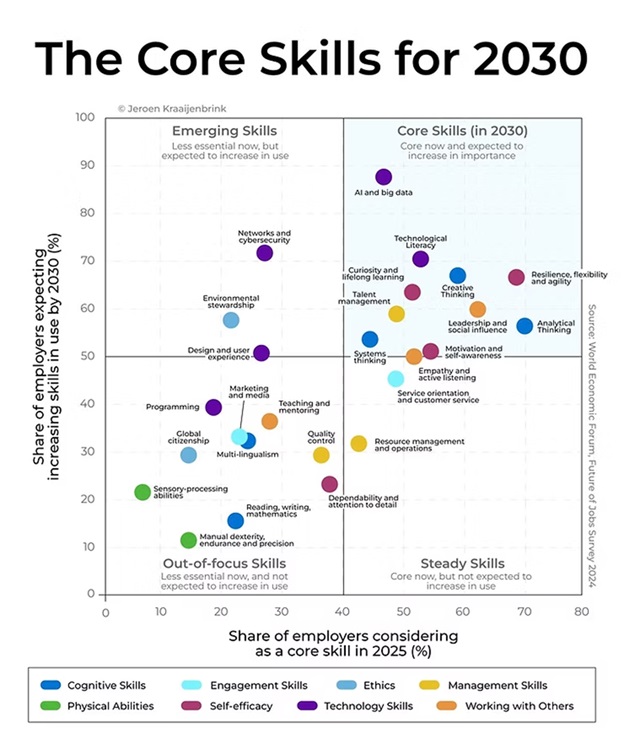
Figure 1: An infographic by Jeroen Kraaijenbrink based on the World Economic Forum Report outlook on skills at https://www.weforum.org/publications/the-future-of-jobs-report-2025/in-full/3-skills-outlook
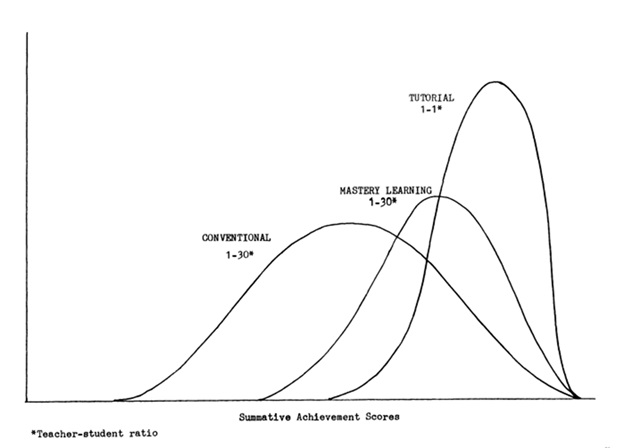
Figure 2: Achievement distribution for students under conventional, mastery learning and tutorial instruction. [3]
 Eng. (Dr.) Damayanthi Herath
Department of Computer Engineering, University of
Peradeniya (UoP) /Data Engineering and Research (DEAR) Group, UoP*
Previous Publications
Issue 62 - October 2024 - Alternative Intelligence (AI): An alternative perspective to artificial intelligence
https://iesl.lk/SLEN/62/Alternative_Intelligence_(AI).php
Issue 61 - June 2024 -Ancient Intelligence (AI) to Artificial Intelligence (AI): A narrative
https://iesl.lk/SLEN/61/Ancient_Intelligence.php


