
Is the 70% RE by 2030 target being sabotaged?
By Eng Parakrama Jayasinghe
With three consecutive Presidents endorsing it, and documented in Parliament, the people of Sri Lanka would have been convinced that the goal of achieving 70% contribution by Renewable Resources for power generation, is a firm national policy in line with the International Commitments made, and therefore a target that all relevant authorities would be obliged to achieve without any argument.
While the target of 70% seemed far too low a target, considering that Sri Lanka had a proud record of being served by nearly 100 % Renewable Energy (RE) based electricity a few decades ago, the gap to be filled from the current 52% up to 70% is a small step indeed. This is the sentiment expressed by the officials of the ADB and the many foreign experts in the field who participated in the recent workshop on “Enhancement of Renewable Energy Development” held in Colombo.
Not unsurprisingly, the Ceylon Electricity Board (CEB) and the Ministry of Energy officials present, chose to express their doubts of reaching this goal. Little did they realize that they were admitting their own incompetence publicly, and telling the people of Sri Lanka that they have no regard for any National Policies. There are some so called “Sri Lankan Experts” who convinced President Gotabhaya to even lower the bar to 70% from the original 80% declared by him in his “Vistas of Prosperity and Splendor”
The historical negative stance of CEB on Renewable Energy
Isn’t it fair to assume that having lowered the target to a level that they admitted was possible, the CEB engineers should have felt it their professional duty, to strive to achieve this, preferably before the set date, and thereby regain their lost prestige. But it looks like, it is too much to expect from the present engineers, at least those who are publicly heard and seen, who have only their self-interest and absolutely no civic sense of serving the consumers who pay their considerable salaries and other benefits. We earnestly believe that there must be a significant number among the 1000 odd engineers, who do not fall into this sorry category. It is time that they do come forward and show that CEB can once more be the most admired public entity, which have made many laudable achievements in the past.
The path created by the Surya Bala Sangraamaya (SBS)
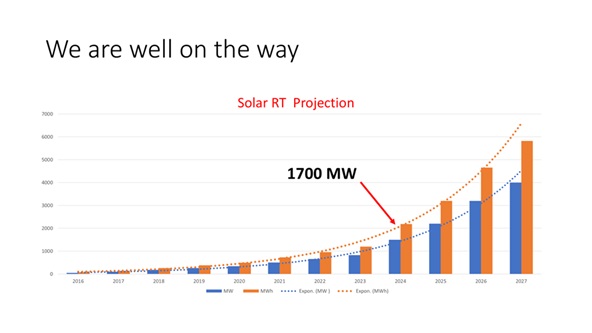
In spite of such lukewarm attitudes of CEB and Ministry, the fortunate circumstances in the market place and the advancement of technologies and the considerable interest of the consumers themselves, there was a hope that we were in fact moving in the right direction. One must give credit to who ever formulated and enacted the most visionary “Surya Bala Sangraamaya (SBS)” project and progressively improved by the schemes of Net Metering, Net Accounting and Net Plus and Net Plus Plus, to attract the different segments of the investors particularly “Prosumers” who account for more than 100,000 such investors on the SBS project. The phenomenal growth of the Roof Top Solar PV shown below is undeniable evidence of this admirable progress.
The other renewable energy projects under the NCRE scheme did not show any acceptable progress, mainly due to apathy and the most dubious schemes adopted by the previous regimes, in total violation of the laws and regulations in place, and the inability of the CEB to launch a successful tender, which does not end up in a multitude of lawsuits. Or the very poor outcome in case of the solar PV tenders for 1 MW capacity, for 60 MW, 90 MW, 150 MW tenders or cumulative capacity, or 75kW solar tender which tied up 7000 rural transformers, thus obstructing the growth of Roof Top Solar, which ended up with zero outcome. Perhaps that was the very intent. Now there is a similar attempt trying to call for international, tenders for 152 MW of solar projects tied to some 18 selected Grid Substations. This in total violation of the Provisions under the NCRE scheme of the Sustainable Energy Authority, which permits projects up to 10 MW to be developed under a Feed in Tariff and a Standardized Power Purchase Agreement. This is the very progressive scheme which resulted in the addition of 167 MW of ground mounted Solar and 263 MW of wind power, 431 MW of Mini Hydro and 54 MW of Dendro power, by Sri Lankan entrepreneurs with absolutely no cost to the CEB or the treasury
The Evidence of Feasibility of reaching 70% RE
However, in spite of such debacles, it is a great comfort and benefit to the people of this country and the CEB which is not acknowledged publicly. Also, we have reached and even surpassed the target of 70% RE on a number of days. One such instance is illustrated below
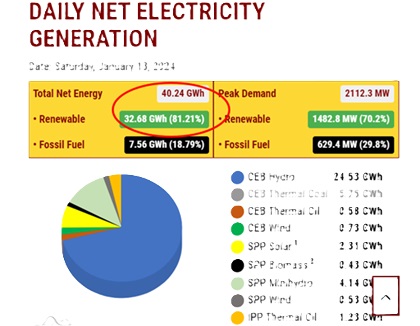
No doubt this was possible due to the favorable rainfall, which enabled a high contribution by the Hydro power both the CEB owned major systems and a considerable input from the 431 MW of mini hydro plants. Any responsible and progressive utility and the incumbent engineers would have celebrated such a momentous event, and publicized and vowed to seek ways and means of achieving such successes progressively on more and more days. Perhaps this would not have fitted their agenda, whereby everything would be done to prevent the achievement of the 70% target which they shamelessly say is not possible.
Some years ago, such a fortunate situation had to be accepted only as an occasional bounty of nature, and there being no means of any intervention to expand the duration of such fortunate circumstances. But since 2016 with the launching of the SBS the situation has changed very much in our favour, with reduced costs and thereby the increased solar and wind generation. The flip side of the regular CEB lamentation that the Hydro generation drops during the dry months every year, which the CEB comes to realize only in January of each year, is that the Solar PV potential is maximum during these months to more than offset the drop in hydro and still be able to maintain at least the 70% RE contribution. Of course, there was a lot that should have been done by the CEB to enable the integration of such “none firm” sources energy, which is not unique to Sri Lanka alone. They have had to admit this lapse due to the recent Monkey incident. At least on paper they projected the essential battery storage in the generation plans. The last approved LTEGP 2023-2042 provided for 300 MW/1170 MWh of batteries by 2026, with 20 MW/ 50 MWh by January 2024.
But absolutely nothing has been done, to even call for a tender. I believe that the Donor agencies were quite ready to provide the funds necessary.
The Impressive Contribution already made by RE to the Economy.
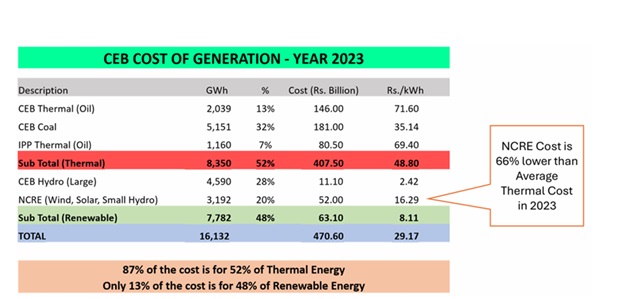
In spite of such singular lack of interest and responsibility of the CEB and the Ministry, the private sector continued their efforts, gritting their teeth in the face if the most negative attitudes of the officials at all levels, to reach a level of 2050 MW of NCRE capacity being 39% of the gross installed capacity, contributing 3192 GWH of energy or 20% of the annual electricity demand. What is of even more significance to the nation is that, each unit of electricity generated using RE, replaced an equivalent unit generated by the imported fossil fuel. Thus, at the present level of integration Sri Lanka saves over 670 million Dollars annually. Using the CEB data for 2023, the average cost of electricity from fossil fuels is Rs 48.80 /kWh whereas the unit generated from RE sources is only Rs. 16.29/kWh. See Chart Below. Therefore, the CEB is saving Rs 103.8 billion annually, by the presence of this sector, on which they were not called upon to spend a cent of capital cost. Therefore, if not for the RE Contribution the CEB would have demanded even higher increase of Consumer Tariff than the 225% increased demanded in August 2022, hiding behind the IMF edicts. The situation remained similar in year 2024.
The Strategy already in place to Sabotage the RE Development.
However, there is a concerted effort by the CEB aided and abetted by the Ministry to reverse this trend over the past few months. The significant negative steps taken are
- Removing of the Net Plus Plus scheme of the SBS, which was a major contributor to the recent spurt of Roof Top Solar PV growth with 600 MW added in the year 2024 alone
- Limiting the approvals under the Net Plus scheme to a percentage of contract capacity irrespective of the potential roof area.
- Adding a clause for allowing curtailment of RE dispatch to the grid without any limit specified. This will prevent any bank from funding the projects.
- Even increased resistance to provide clearances for new RTSPV projects
- The most factually unfounded attempt to blame the sector for the island wide black out on the 9th Feb 2025
- The unlawful curtailment of Solar, Wind and even Mini Hydro projects on Sundays during the hours of highest generation
- Stopping approvals for all new solar Roof Top projects
- The most unprofessional recommendations of a Ministry appointed committee to drastically reduce the level of Feed in Tariff for RE projects, which the Minister has without any attempt to evaluate the veracity has blindly submitted to the Cabinet for approval
- The specific admission by the Secretary of Power and Energy of their decision to discourage the development of Renewable Energy
- A Cabinet paper to approve a second LNG based power plant based on patently false parameters and deceitful forecast of cost of generation, when there is already one LNG plant completed without any visible means of obtaining the LNG required at an acceptable price, to qualify as a candidate for Least Economic Cost of Generation in merit order dispatch.
- The Attempt to amend the positive and progressive clauses in the already approved Electricity Act No 36 of 2024, which would have facilitated the rapid development of the Renewable Energy, by a draft Bill already submitted to the parliament. Fortunately, seven petitions against the provisions of these amendments have been submitted to the Supreme Court. Hopefully some sanity would prevail.
Who is heading the task of destruction of RE?
There are many accusations that the hand behind all these, could be the new chairman of the CEB who has now resigned. This is not surprising given the fact that he is a well known promoter of coal and imported fossil fuels and to be a detractor of renewable energy.
But what is most surprising is the attitude and role played by the Minister of Energy, the representative of the Government. This government came in to power on a Manifesto replete with many promises of enhancement of the renewable energy development, and with a specific goal of adding 2000 MW of roof top solar systems, and reducing the dependence on imported fossil fuels and for a people centric power sector. All of the above retrogressive steps have been taken with the approval of the Minister. The generous interpretation of such unfathomable blind rubber stamping is, that he is unable to see the damage caused to the electricity sector and Sri Lanka at large. I hesitate to conjecture on any other reasons. In that light what is the role played by the rest of the Cabinet, on these proposals which would have a highly negative impact on National Economy?
However, if the present trend is allowed to proceed, not only the target of achieving the 70% RE by 2030 will remain a dream and the President can say good bye to the principles of
- Energy as an essential national service
- Sustainable and secure energy supply
- Energy Economy as a source of foreign exchange
Which generated so much support for the NPP and hope for the electricity consumers,
Is His Excellency the President unaware of these attempts?
As such it is very urgent for His Excellency the President to intervene in this critical situation if the electricity sector is not to slide back to the era of blackouts and increased drain of foreign exchange for the continued import of expensive fossil fuels, which we can ill afford. Even at this stage we urge His Excellency to formally assign the responsibility of achieving the target of 70% RE by 2030 to the CEB, with a demand for an annual mile stone plan, for intermediate targets to be achieved year by year. Otherwise, it is no one’s baby and as seen above it is fast heading towards the dust bin.
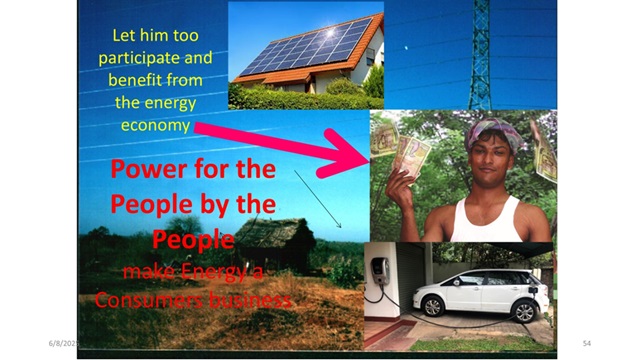
The very good fortune Sri Lanka enjoys with the bounty of nature by way of massive RE potential is the property of people. It is time that the Government and Particularly the CEB appreciates this, which we hoped was accepted by the present Govt. Thus, the future energy sector cannot deviate from
 Eng. Parakrama Jayasinghe
is a Chartered Mechanical Engineer with a BSc Eng (honours) degree from the University of Peradeniya. He is fellow of the Institution of Engineers Sri Lanka and a Member of the Institution of Mechanical Engineers London.


Recent SLEN articles by the same author
Consumer Tariff can be reduced substantially by eliminating Oil based generation with Indigenous Renewable Energy (Issue 63 : March 2025)
https://iesl.lk/SLEN/63/Indigenous_Renewable_Energy.php
Every man or Woman for Himself in the Electricity Sector (Issue 61 : June 2024)
https://iesl.lk/SLEN/61/Electricity_Sector.php
The Importance of Renewable Energy for Future Energy Security and Economic Growth (Issue 61 : June 2024 )
https://iesl.lk/SLEN/61/Importance_of_Renewable_Energy.php
Are we to burn the Dollars borrowed, just to Cook a Meal ? (Issue 60 : October 2022 )
https://iesl.lk/SLEN/60/Are_we_to_burn_the_Dollars_borrowed.php
A Productive Way out of the LNG Dilemma! (Issue 59 : December 2021 )
https://iesl.lk/SLEN/59/LNG_Dilemma.php
Sri Lanka’s Savior Can be the Ceylon Electricity Board (Issue 58 : September 2021)
https://iesl.lk/SLEN/58/Response_to_the_Pod_Cast.php
The Elephant in the Room – Transport Energy (Issue 53 : April 2021 )
https://iesl.lk/SLEN/53/Transport%20Energy.php
The Origin and Way out of the Energy Crisis - Part 1 (Issue 44 )
https://iesl.lk/SLEN/44/energy.php
A Simple Paddy Dryer – Innovation in Practice (Issue 30 : November 2016 )
https://iesl.lk/SLEN/30//A-Simple-Paddy-Dryer.php
A Road Map for an Energy Independent Sri Lanka by 2030 (Issue 28 : March 2016 )
https://iesl.lk/SLEN/28//A-Road-Map-for-an-Energy-Independent-Sri-Lanka-by-2030.php
The Hidden Face of Coal Power (Issue 27 : February 2016 )
https://iesl.lk/SLEN/27//The-Hidden-Face-of-Coal-Power.php