
“Can Vegetation Really Stabilize Riverbanks? Ongoing researches at the University of Moratuwa”
By Eng. M.D.J.P.Wickramasooriya and Eng. (Prof.) U.P.Nawagamuwa
Why Riverbank Failures Matter in Sri Lanka
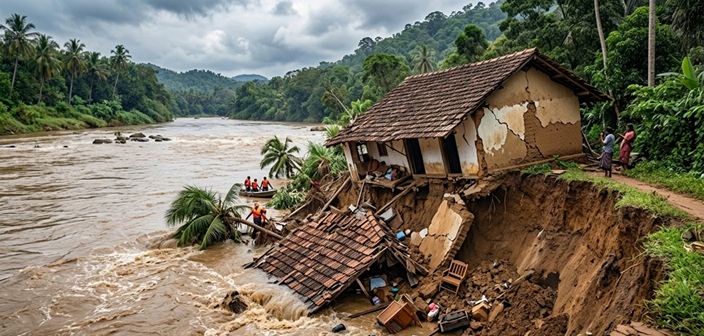
Riverbank failures are a recurring and increasingly critical issue along major river systems in Sri Lanka, particularly in urbanized areas. Some river basins drain high-rainfall catchments and are subject to rapid fluctuations in flow, especially during monsoonal periods. As a result, riverbanks are frequently exposed to erosion, toe undercutting, and slope instability, particularly in alluvial and unconsolidated to poorly consolidated soils.
The consequences of such failures are significant and complicated. Riverbank failures can lead to localized flooding, loss of residential land, and damage to critical infrastructure such as roads, bridges, and river networks. In densely populated floodplains, even small-scale bank failures can disrupt many livelihoods and impose considerable economic costs on communities and authorities.
These challenges are further intensified by the climate changes, with more frequent extreme rainfall events and prolonged wet periods. Such conditions elevate river discharge, riverbanks get saturated, and reduce soil shear strength. This highlights the urgency of adopting sustainable and adaptive riverbank protection strategies in the Sri Lankan context.
Traditional Riverbank Protection: Are They Enough?
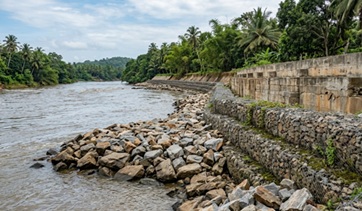 Traditional riverbank protection measures in Sri Lanka have largely relied on hard engineering solutions such as rock riprap, gabion walls, concrete retaining structures, and revetments. These approaches are widely implemented along major rivers, particularly in areas where infrastructure and urban settlements require immediate protection. While such methods can provide rapid stabilization and are effective against direct hydraulic forces, they often come with high construction and maintenance costs, and may not perform well under extreme hydrological conditions.
More importantly, these conventional solutions tend to overlook the dynamic and ecological nature of river systems. Rigid structures can alter natural flow patterns, change flow velocities, and cause erosion problems downstream rather than resolving them. In some cases, failure of these structures can be unexpected and disastrous. Given the increasing frequency of high-intensity rainfall events and flooding due to the current climate changes, it is increasingly evident that traditional methods alone may not offer long-term, sustainable resilience. This has prompted growing interest in complementary approaches, particularly nature-based solutions, which aim to work with natural processes rather than against them.
Nature-based Solutions (NbS): What Do They Mean in Practice?
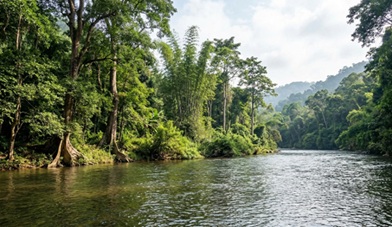 “Nature-based Solutions (NbS)” refer to strategies that utilize natural processes and ecosystem functions to address engineering and environmental challenges in a sustainable manner. As defined by the International Union for Conservation of Nature, NbS are actions that protect, sustainably manage, and restore natural or modified ecosystems while simultaneously providing human well-being and biodiversity benefits. In the context of riverbank protection, NbS primarily involve the use of vegetation and bioengineering techniques to enhance riverbank stability and reduce erosion.
Unlike conventional hard engineering approaches, NbS enhance the shear strength of the soil by reinforcing soil through root systems and increasing the matric suction of the soil due to root water uptake by evapotranspiration. Further NbS may provide surface protection against rainfall impact and flow-induced erosion. In river systems across Sri Lanka, species such as Bamboo (Bambusa vulgaris), Kumbuk (Terminalia arjuna), Walbeli (Hibiscus tiliaceus) and many native trees are increasingly being explored for their potential to provide cost-effective and environmentally compatible stabilization. These approaches not only contribute to engineering stability but also enhance ecological resilience and landscape value.
How Vegetation Actually Improves Stability
These mechanisms can be understood in very simple, practical terms:
• Root reinforcement:
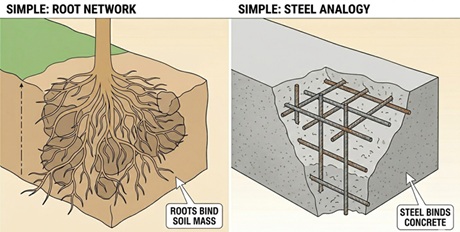
Vegetation roots act like natural fibres within the soil. They bind soil particles together and increase resistance against shear failure, similar to how steel reinforcement works in concrete. This added strength helps the riverbank resist sliding and collapse.
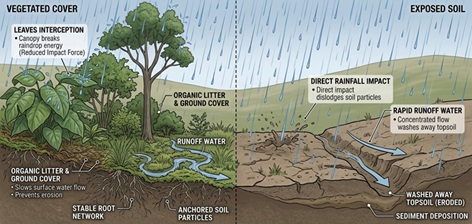
• Reduction of surface erosion:
Vegetation covers the soil surface and protects it from direct rainfall impact and run-off water. Leaves reduce raindrop energy, while stems and ground cover slow down runoff, preventing the topsoil from being washed away.
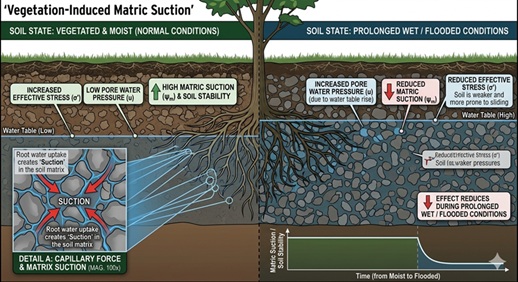
• Suction effects (during unsaturated conditions):
Vegetation roots absorb water, creating a “suction” in the soil. This suction reduces the pore water pressure, increases the effective stress and matric suction, and improves soil stability. However, this effect reduces during prolonged wet or flooded conditions.
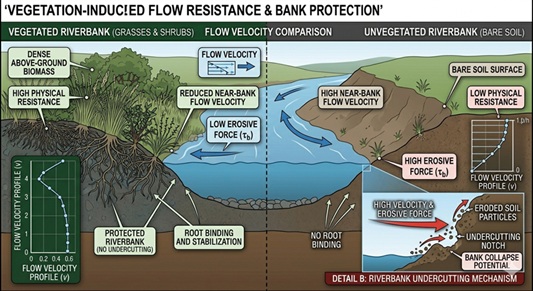
• Flow resistance (reduces velocity near banks):
Vegetation such as grasses and shrubs creates physical resistance to flowing water. This reduces the flow velocity near the riverbank, lowering the erosive force acting on the soil and helping to protect the bank from undercutting.
Ongoing research Studies at the University of Moratuwa
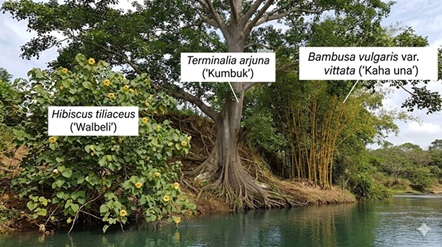 Ongoing researches at the University of Moratuwa focuses on advancing the application of Nature-Based Solutions (NbS) for riverbank stabilization under Sri Lankan conditions. One such research investigates the geotechnical performance of vegetation-based systems, with particular emphasis on root-induced enhancement of shear strength in riverine environments due to Hibiscus tiliaceus (“Walbeli”), Terminalia arjuna (“Kumbuk”), and Bambusa vulgaris var. vittata (“Kaha una”). The study aims to quantify how plant root networks contribute to increased soil shear strength and overall slope stability, especially in alluvial and residual soils commonly found along the Kelani River bank which is one of the major rivers in Sri Lanka. Further, the results of a recent study carried out at University of Moratuwa by Madhushan et.al [1] demonstrated that root reinforcement by Hibiscus tiliaceus consistently improved the factor of safety, with increases ranging from 12% to 38%, depending on slope geometry and river water level. Furthermore, another recent study by Kaushalya et.al [2] investigated the influence of matric suction on root reinforcement of the Alstonia macrophylla with selected soil using large-scaled direct shear tests by carrying the soil suction. Moreover, several additional publications are forthcoming.
Limitations: When Vegetation Alone is Not Enough
While vegetation offers clear benefits, it is not a standalone solution for all riverbank stability problems in Sri Lanka. One key limitation is the depth of influence of roots. Most grasses and even many trees reinforce only the near-surface soil layer, whereas critical slip surfaces may develop at greater depths. In such cases, vegetation alone cannot provide sufficient shear resistance to prevent large-scale slope failures.
Vegetation is also less effective under extreme hydraulic conditions. During high floods, strong flow velocities and prolonged submergence can erode the bank toe and reduce the stabilizing effects of roots and suction. Normally it was seen that this scenario happens in bank failures with bamboo culms. Additionally, the beneficial suction effect disappears when soils become fully saturated, which is common during intense and continuous rainfall events. There is also a time factor—vegetation requires a growth period to establish an effective root network, making it unsuitable for sites requiring immediate stabilization.
Furthermore, inappropriate species selection or poor maintenance can reduce effectiveness and, in some cases, even contribute to instability (e.g., tree uprooting or added surcharge). These limitations highlight the need to combine vegetation with conventional engineering measures, forming hybrid solutions that balance immediate protection with long-term sustainability.
The Way Forward: Combining Nature and Engineering
The way forward for sustainable riverbank protection in Sri Lanka lies in integrating nature-based solutions with conventional engineering approaches. Rather than viewing vegetation and hard structures as alternatives, they should be designed as complementary systems. For example, combining toe protection using rock boulders or gabions with vegetation on the upper bank can address both deep-seated and surface-level instability. This hybrid approach is particularly relevant along dynamic rivers, where hydraulic forces and soil conditions vary significantly along the reach.
Such integrated designs offer multiple benefits: immediate structural stability from engineered elements, and long-term resilience through vegetation that enhances soil strength, reduces erosion, and improves ecological value. In addition, these approaches are often more cost-effective over the lifecycle of a project, as vegetation can reduce maintenance needs and adapt naturally to changing environmental conditions.
Moving forward, greater emphasis should be placed on site-specific design, proper species selection, and performance monitoring. Collaboration between engineers, ecologists, and policymakers is essential to develop guidelines suited to local conditions. By combining engineering reliability with natural processes, Sri Lanka can move toward more resilient and environmentally sustainable riverbank protection strategies.
“A Shift in Mindset: From Hard Engineering to Smart Engineering”
A meaningful transition in riverbank protection in Sri Lanka requires a shift in mindset—from relying solely on hard engineering toward adopting “smart engineering” approaches. Traditional methods have largely focused on resisting nature through rigid structures; however, growing field evidence from rivers shows that working with natural processes can often deliver more resilient and adaptive outcomes. Smart engineering does not reject conventional solutions but redefines their role within a broader, system-based perspective.
For further reading, please refer to the following publications:
[1] L. G. C. Madhushan, U. P. Nawagamuwa, and M. D. J. P. Wickramasooriya, “Enhancement of river bank stability by Hibiscus tiliaceus root reinforcement: A nature-based solution,” ENGINEER Journal of the Institution of Engineers Sri Lanka, vol. LLX, no. 1, pp. 25–34, 2026.
[2] A. S. Kaushalya, M. A. Pallewattha, and U. P. Nawagamuwa, “Improvement of shear strength properties of Sri Lankan silty sand due to tree roots of Alstonia macrophylla,” Geotechnical Journal, Sri Lanka Geotechnical Society, vol. 9, no. 1, pp. 21–29, Dec. 2024.
 Eng.M.D.J.P.Wickramasooriya
B.Sc.Eng.Hons (Moratuwa), M.Sc.Eng. (Peradeniya)
FIE(SL), C.Eng(SL), IntPE(SL), MIEAust, CPEng (Australia), APEC, NER, IntPE(Aus)
Post graduate student, University of Moratuwa, Sri Lanka
Malabe,
Eng.M.D.J.P.Wickramasooriya
B.Sc.Eng.Hons (Moratuwa), M.Sc.Eng. (Peradeniya)
FIE(SL), C.Eng(SL), IntPE(SL), MIEAust, CPEng (Australia), APEC, NER, IntPE(Aus)
Post graduate student, University of Moratuwa, Sri Lanka
Malabe,
 Eng. (Prof.) U.P.Nawagamuwa
B.Sc.Eng.Hons(Moratuwa), MEng (AIT), DrEng (YNU), CEng, FIE(SL),
Professor, Department of Civil Engineering,
University of Moratuwa, Sri Lanka
Eng. (Prof.) U.P.Nawagamuwa
B.Sc.Eng.Hons(Moratuwa), MEng (AIT), DrEng (YNU), CEng, FIE(SL),
Professor, Department of Civil Engineering,
University of Moratuwa, Sri Lanka