
Nature-Based Provisional Resettlement Shelters Offer a Sustainable Path Forward for Diththwa Cyclone Victims
By Eng. Himal N. Hikkaduwa
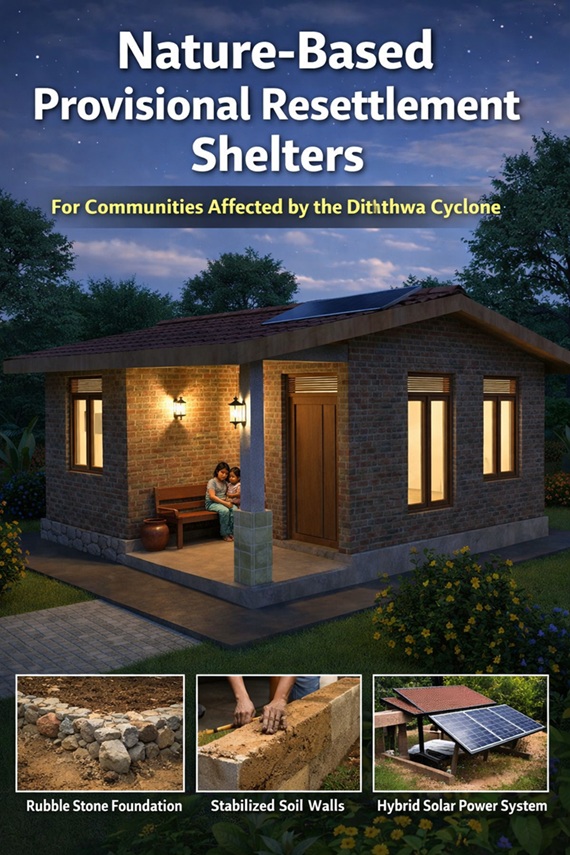
The Diththwa Cyclone will be remembered not only for its destructive winds and torrential rains, but for the uncomfortable truths it revealed about Sri Lanka’s preparedness for climate-induced disasters. Sweeping across multiple districts, the cyclone left behind a trail of devastation to housing, public infrastructure, and livelihoods, displacing thousands of families and placing immense pressure on emergency response systems. For many affected communities, the disaster did not end when the storm clouds cleared; it continues in the form of prolonged displacement, unsafe living conditions, and uncertainty about the future.
According to the National Post-Disaster Needs (NPD) Assessment, the cyclone affected nearly two million people and more than half a million households nationwide. Over 4,000 houses were completely destroyed, while more than 40,000 housing units sustained partial damage severe enough to render them unsafe or uninhabitable. Thousands of families remain displaced due to structural instability, flood risks, landslide threats, and the loss of basic services. These figures point to a housing crisis of significant scale one that cannot be addressed through conventional, material-intensive responses alone.
Beyond the immediate humanitarian impact, the Diththwa disaster has exposed a deeper structural challenge. As climate change intensifies the frequency and severity of extreme weather events, Sri Lanka must rethink how it approaches post-disaster housing. Temporary shelters can no longer be treated as short-term stopgaps. Instead, they must be resilient, cost-effective, environmentally responsible, and capable of rapid deployment under economic and logistical constraints.
Rethinking Post-Disaster Shelter Policy
Traditional post-disaster housing solutions rely heavily on cement blocks, steel frames, prefabricated panels, and long supply chains. That also contributes to high carbon & water footprints. In the aftermath of major disasters, these materials are often in short supply, subject to price escalation, and dependent on imports. The result is delayed implementation, increased public expenditure, pressure on foreign exchange reserves, and prolonged displacement for affected families.
In this context, a nature-based provisional resettlement shelter model presents a compelling alternative. By prioritizing locally available materials, community participation, and circular construction principles, such shelters align disaster response with broader national priorities economic stability, environmental sustainability, and social resilience.
Nature-based construction draws from materials that are readily available in affected areas: stabilized soil for wall construction, reused boulders and debris from landslides and demolished structures for foundations, locally sourced timber particularly softwood and indigenous roofing materials such as clay tiles. These materials originate from the local environment and, importantly, can return to it at the end of the shelter’s life cycle with minimal ecological harm.
For policymakers, this approach offers tangible advantages. Reduced reliance on imported materials eases pressure on foreign reserves. Local sourcing shortens supply chains and accelerates construction timelines. At scale, these efficiencies translate into significant fiscal savings and faster recovery outcomes.
A Shelter Designed for Dignity and Resilience
The proposed nature-based shelter model has been carefully designed to balance simplicity, durability, and human dignity. With an approximate floor area of 550 square feet, the layout accommodates the basic needs of a typical family while ensuring privacy, protection, and ease of construction.
The design includes two bedrooms, a combined living and dining space, a compact kitchen, a washroom, and an open veranda. Spatial planning clearly separates private, semi-private, and service areas, enhancing functionality in a limited footprint. The open veranda serves as a shaded transitional space, improving ventilation, providing protection from rain, and allowing social interaction with the surrounding community.
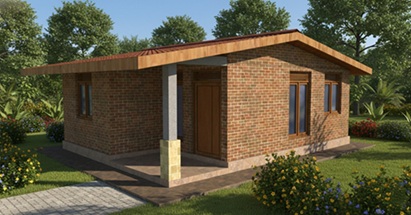
A simple two-pitch roof enhances resistance to heavy rain and strong winds, while extended eaves offer shading and climatic comfort. Nine-inch-thick soil-concrete walls provide structural stability and thermal mass, moderating indoor temperatures and reducing the need for artificial cooling. A plain concrete floor with a cut-and-polished finish ensures durability, low maintenance, and cost efficiency critical factors in temporary housing programmes.
Foundations Built from Recovery Itself
One of the most innovative aspects of the shelter model lies beneath the ground. Foundations are constructed using random rubble masonry, incorporating boulders and stones recovered from landslides, damaged house foundations, and demolition debris. This approach reduces the demand for newly quarried stone, minimizes construction waste, and lowers transportation costs.
Properly selected and placed, reused rubble provides a strong and stable foundation capable of distributing loads effectively. When combined with appropriate binding materials, such foundations offer long-term durability and structural reliability, making them well suited for temporary shelters in disaster-prone areas.
Proven Materials, Backed by Research
The use of soil-concrete walls is not experimental. Their structural and durability properties have been validated through multiple research studies conducted in Sri Lanka. Full-scale mock-up walls constructed and exposed to severe environmental conditions for several years have demonstrated long-term performance and resilience. Further you can refer it through YouTube channel Himal Hikkaduwa (www.youtube.com/watch?v=M4tr3MHJkxg).
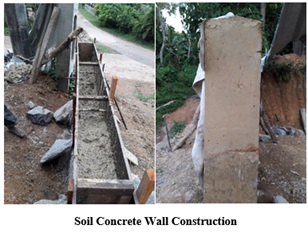
Beyond strength, soil-concrete offers significant thermal benefits. Its high thermal mass helps stabilize indoor temperatures, improving comfort in hot and humid conditions. The fair-face finish eliminates the need for plastering and painting, reducing construction time, costs, and future maintenance an essential consideration when thousands of units must be built quickly.

Speed through Smart Construction
Time is a critical factor in post-disaster recovery. To meet urgent shelter needs, the proposed model incorporates system formwork or slip-form construction techniques. This allows walls to be built rapidly while embedding door and window frames, as well as basic electrical and plumbing services, during construction.
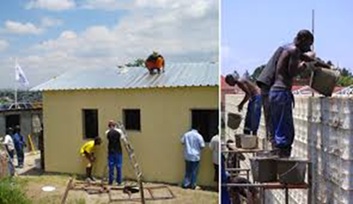
System formwork; Source https://inhabitat.com/plastic-formwork-system
Standardization of the 550-square-foot layout enables formwork to be reused across multiple units, ensuring consistent quality while significantly reducing labour and construction time. For implementing agencies, this approach offers predictability, scalability, and efficient use of limited resources.
Economic Recovery Begins at Home
Beyond shelter provision, nature-based construction plays a vital role in stabilizing local economies after disasters. By engaging affected communities in planning and construction, the approach generates local employment, sustains small and medium enterprises, and revitalizes regional markets.
Income earned through construction work directly supports household purchasing power and helps restore livelihoods disrupted by the cyclone. Reduced dependence on external contractors and imported materials keeps capital circulating within the local economy, creating multiplier effects that extend well beyond the housing sector.
Community participation also delivers social benefits. Involvement in rebuilding fosters a sense of ownership, restores dignity, and provides psychosocial support for families recovering from trauma. Collective rebuilding strengthens social networks, rebuilds trust, and reinforces traditional cooperation mechanisms key ingredients of long-term resilience.
Energy Resilience and Safety
Energy insecurity is a common challenge in post-disaster settings. The shelter model addresses this through a hybrid energy system that combines low-voltage solar power for lighting and ventilation with limited grid electricity for essential appliances. This reduces household energy costs, improves reliability during power disruptions, and enhances safety by minimizing electrocution risks in wet environments.
Planning for the End from the Beginning
Temporary shelters often become permanent by default, leaving behind environmental waste and stranded public investment. The proposed nature-based model avoids this trap through end-of-use planning. Soil-concrete walls can be dismantled and reused as backfill or construction material, while timber, roofing elements, doors, windows, and solar systems can be recovered for future projects.
In doing so, public funds invested in temporary housing continue to deliver value long after permanent resettlement is complete.
A Policy Opportunity Not to Be Missed
The Diththwa Cyclone has delivered a clear message: Sri Lanka must move beyond ad hoc disaster responses. Nature-based provisional resettlement shelters offer a practical, scalable, and sustainable pathway forward one that aligns humanitarian response with climate adaptation, fiscal responsibility, and inclusive development.
For policymakers, ministries, and implementing agencies, the opportunity now lies in mainstreaming such approaches into national disaster housing strategies. Doing so would not only address immediate shelter needs but also lay the foundation for a more resilient, self-reliant, and climate-smart future.
 Eng. Himal Hikkaduwa
He currently serves as an Assistant Director at the Construction Industry Development Authority and has previously worked as a Water and Habitat Engineer with the International Committee of the Red Cross (ICRC). He holds an MSc in Disaster Management from the University of Peradeniya and is a Member of the Association of Disaster Risk Management Professionals (Sri Lanka), bringing together strong technical expertise and practical experience in disaster risk reduction and humanitarian engineering.